No products in the cart.

+1416-778-1390
2155 Lawrence Ave East Toronto M1R 5G9
1217 Barnswallow Court Mississauga L5V 2J6
an energy practice, generally encompassing simple movements and postures. Some Qigong systems also emphasize breathing techniques.
the use of herbal combinations or formulas to strengthen and support organ system function Acupuncture: the insertion of needles in acupoints to help Qi flow smoothly.
the prescription of certain foods for healing based on their energy essences or energy signatures, not nutritional value.
the understanding of emotions and their relationship to the internal organ systems and their influence on health.

1. Energy or power.
2. Information or
3. intelligence
that guides body functions. Each Organ System in TCM has its own special kind of Qi, helping it do both physical tasks (like those recognized by Western medicine) and energy-based tasks (unique to TCM). The word “Organ” (with a capital “O”) in TCM includes both the physical organ and its energetic role in the body.
Common Qi Problems in TCM There are a few key problems related to Qi in Chinese medicine:
Qi and Blood Work Together In TCM, Qi and blood are deeply connected:
TCM says this happens because of blood loss, not infection. Without enough blood, there’s a lack of Qi, and that can cause problems like fever.
Here’s a concise version with only the five elements as bullet points:
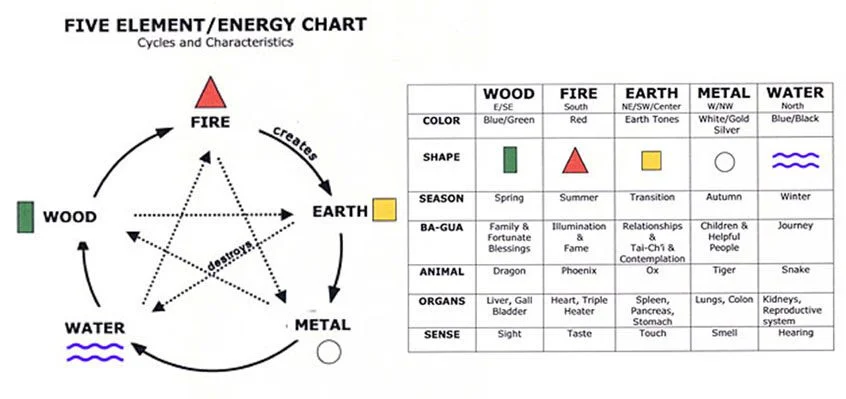
Wood / Spring – Growth, abundant wood and vitality (72 days)
Fire / Summer – Swelling, flowering, full of energy (72 days)
Earth – Transitional periods or Late Summer, leveling and fruition (72 days)
Metal / Autumn – Harvesting and collecting (72 days)
Water / Winter – Retreat, stillness, and storage (72 days)
The Five Elements—Wood, Fire, Earth, Metal, and Water—describe natural changes and cycles in the world:
Wood / Spring (72 days) – A time of growth and renewal, full of life and energy
Fire / Summer (72 days) – A period of expansion, warmth, and activity
Earth / Late Summer or Transition Periods (72 days) – Times of balance, moderation, and preparation between seasons
Metal / Autumn (72 days) – A season of harvesting, gathering, and letting go
Water / Winter (72 days) – A quiet period of rest, reflection, and storage
In Traditional Chinese Medicine (TCM), meridians are invisible pathways that carry Qi (life force energy) throughout the body. These channels form an intricate network that links all parts of the body—including organs, skin, bones, and even individual cells—and also connect the body to nature and the universe. TCM identifies 12 primary meridians, each associated with a specific organ system.
The meridian system can be compared to a network of highways and roads that connect major cities. In this analogy, the highways represent meridians and the cities represent organs. Energy (Qi) flows through this system just like traffic moves through roads.
When Qi becomes blocked in a meridian, it can cause dysfunction in the associated organ, and if left unresolved, the imbalance may spread and affect other systems as well.
TCM is also based on the idea that everything in the universe is made up of two opposite but connected energies: Yin and Yang. They are not enemies but partners. You cannot have one without the other. This relationship is shown in the famous Yin/Yang symbol, where each side contains a part of the other.
Harmony also means that your body adjusts to seasonal and environmental changes. If your energy can’t adapt to a new season, you may get sick.
Yin and Yang are relative. For example: Sun and day are Yang, while moon and night are Yin.Morning is Yang compared to the afternoon, which is more Yin.In the body, men are more Yang and women are more Yin.
Every part of the body is influenced by the balance between Yin and Yang. If one is weak or out of sync, the other is affected too. In TCM, the goal is not just balance, but harmony. Balance means equal amounts, while harmony means that Yin and Yang work together naturally, blending into one flowing system. This is called homeostasis, or inner balance.
